You have an idea for a business, a new service or a new product line. It feels obvious, the people around you find it "interesting", and you have already started picturing the website, the logo and the first order. Before going further, ask yourself one question: what proves that someone will pay for this?
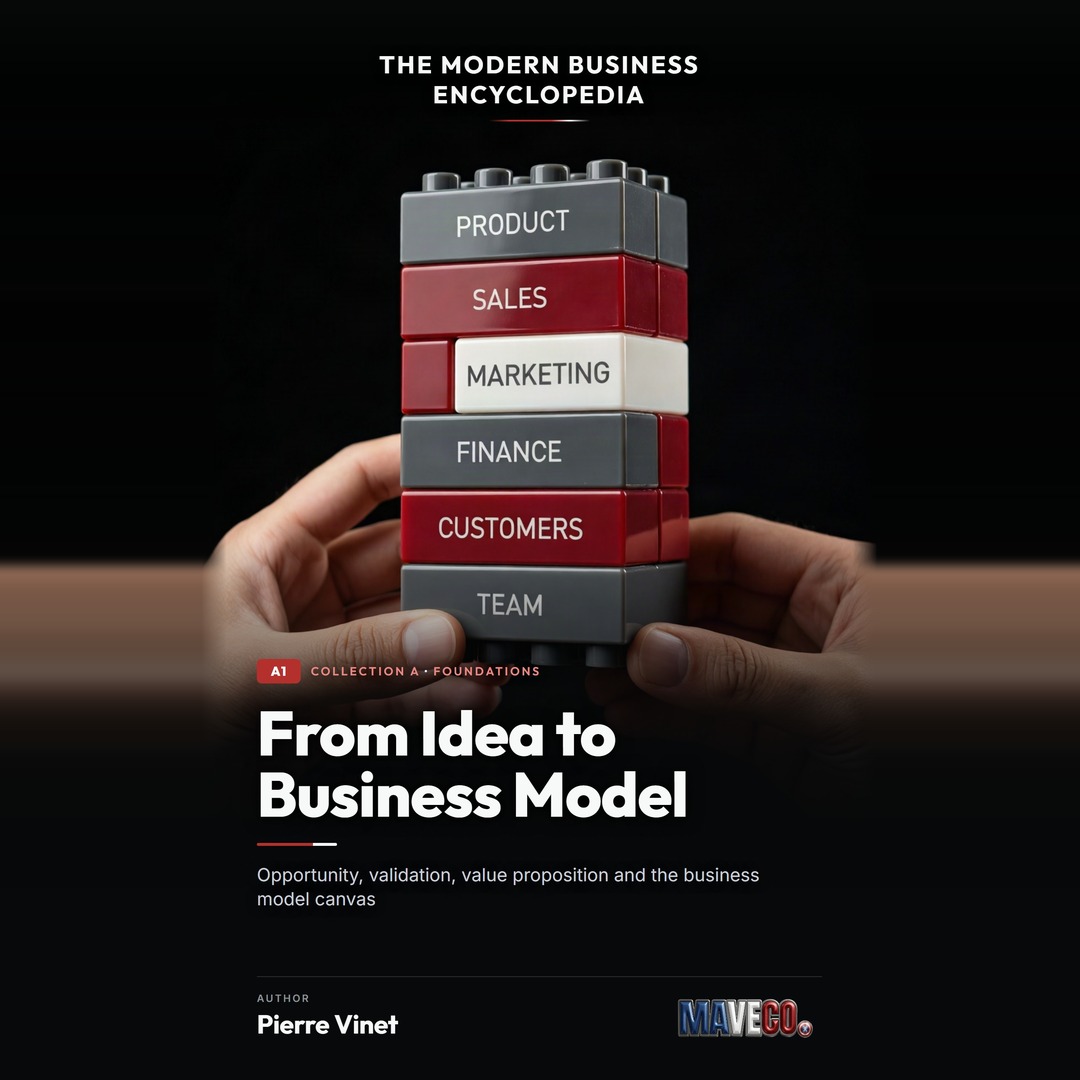
That question is at the heart of From Idea to Business Model, the first book of The Modern Business Encyclopedia, the La Machine business library by Pierre Vinet. You can read it free on maveco.ca. Here is what to take from it, and how to apply it in your business.
An idea is not a business model
The idea is what you would like to exist. The business model is the logic that explains who you create value for, how that value reaches the customer, and how the money you collect exceeds the money you spend — repeatedly, and at a scale worth the effort.
The book frames the model as nine questions, the blocks of the well-known Business Model Canvas:
- Who are your customers, and which group comes first?
- What do they get from you that they value more than the alternatives?
- Through which channels do they discover you, buy and receive the offer?
- What kind of relationship do they expect: self-service, personal assistance, a community?
- How does the money come in, from whom, and for what?
- Which resources must you own or control?
- Which activities must you perform well?
- Without which partners and suppliers does the model not work?
- What does all of it cost, in fixed costs and in costs that grow with each sale?
A business that can answer all nine questions coherently has a business model. A business that answers them with evidence rather than with hopes has a validated business model. The whole book is about the distance between the two.
Why most ideas fail
Ideas rarely fail for lack of talent or effort. They fail because a model that was never tested meets a market that was never asked.
The book draws on CB Insights' March 2026 analysis of 431 venture-backed companies that shut down since 2023. Among those whose reasons could be identified, 70% cited running out of capital, 43% poor product-market fit, 29% bad timing or macroeconomic conditions, and 19% unsustainable unit economics. Running out of capital is mostly a symptom: money runs out because customers did not come, did not stay, or did not pay enough.
The most common trap has a name: the solution in search of a problem. You build first and look for customers later. Every conversation then becomes a sales conversation, in which the founder hears "that's interesting" as "I would buy that." Twelve months later, the founder discovers that interest and payment are different things.
The arithmetic that changes everything
The book runs the numbers with illustrative figures. Someone who works on a venture fifteen hours a week for a year, plus a contractor, legal fees and a launch campaign, commits about $84,000 before the first real customer conversation.
The validation work the book proposes costs about $7,900 over one quarter: six hours a week for thirteen weeks, a landing page, a prototype, tools, and one hour of a lawyer's time to frame pre-orders. Less than a tenth.
That quarter does not guarantee success. It guarantees that if the building year happens, it rests on a model whose riskiest assumptions have already survived contact with customers.
What the book teaches you to do
Across 14 chapters, From Idea to Business Model takes an idea to a validated business model, one step at a time:
- spot and score opportunities by how often and how badly the problem hurts, and by willingness to pay;
- run customer interviews about past behaviour, not polite opinions;
- write a value proposition the customer recognizes as their own;
- size the market and choose a first segment;
- fill in the Business Model Canvas with evidence, block by block;
- work out unit economics: acquisition cost, customer value, margin per sale;
- test the riskiest assumptions first, then decide: persevere, pivot or stop;
- follow a 30-60-90-day plan, with the ten numbers to watch.
Every method is adapted to three situations: the solo founder, the founding team, and the established business launching something new. Boxed notes give the rules specific to Québec and Canada, dated and sourced.
Already in business?
The book is not only for people starting out. A company launching a new service, entering a new market or revisiting its pricing does exactly the same work: state its assumptions, rank them by risk and test them before investing. The difference is that it already has customers, data and a sales team, so evidence is easier to get.
How MAVECO can help
Validating a business model takes time, method and an outside view. That is the work MAVECO supports every day for small and mid-sized businesses in Québec:
- business planning and strategic growth planning;
- target customer identification and needs analysis;
- profitability analysis of products and services, and pricing optimization;
- grant applications to fund a launch or an expansion.
📘 Read the book free: From Idea to Business Model.
📅 Let's talk about your project: book a meeting with a MAVECO representative. In 30 minutes, we will tell you frankly where to start.
Frequently asked questions
What is the difference between a business model and a business plan? A business model explains how a company creates, delivers and captures value. A business plan turns that model into forecasts and actions for a lender, an investor or a partner. Writing the plan before validating the model produces forecasts that multiply every untested assumption.
How long does it take to validate a business idea? The book proposes one quarter of discovery work, about 90 days at a few hours a week, before committing significant money to building.
What is the Business Model Canvas? It is a tool that describes a business model in nine blocks: customer segments, value proposition, channels, customer relationships, revenue streams, key resources, key activities, key partners and cost structure.
Is the book free? Yes. From Idea to Business Model is free to read on maveco.ca.
General information for educational purposes only. This article is not legal, tax, accounting or financial advice. Consult a qualified professional before acting.