
Volume 1
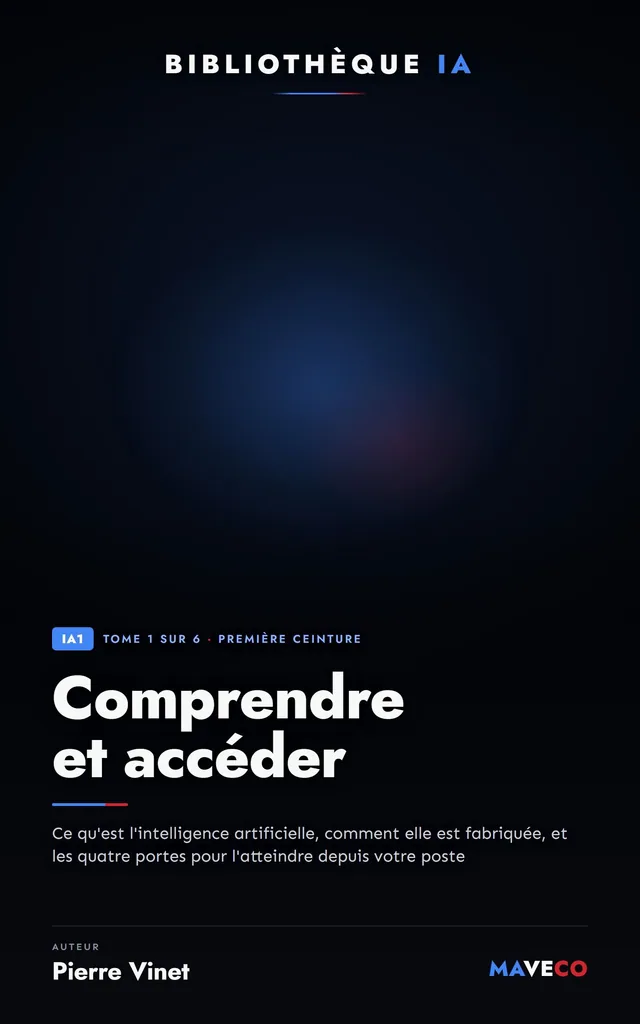
Understand and Access
A French-language primer on what AI is, how models are built and the four doors to reach one, for Windows 11, macOS and Ubuntu.
DiscoverFrench-language books
A six-volume collection, written in French, that takes you from accessing your first AI model to governing AI in an organization, one piece at a time.
6 volumes63 chapters1,672 pages





The six volumes are read in order. Each one leads to one or two belts and assumes the previous ones, nothing more.
Belt 1
Set out the definitions, the science and the four doors to a model.
Belt 2
Learn what a model can do, modality by modality, and chain those tasks without ever ceasing to check.
Belt 3
Give a model memory and your documents: embeddings, vector databases, RAG.
Belt 4
Connect, test and secure tools, sandboxes, permissions, connectors, MCP and secrets.
Belts 5 and 6
Assemble the agent and its harness, then workflows, triggers, graphs and orchestration.
Belts 7 and 8
Observe, evaluate, secure and cost a system, assemble complete environments, then govern, deploy and train.
Eight commitments a reader can verify by opening a book.
A progression in eight belts: every part of the collection except the last ends with a grading exercise, a hands-on workshop whose result can be verified, and every volume closes with the cheat sheet for its belt or belts.
One rule held to the end: no piece is explained before the pieces it contains, so every chapter builds on the ones before it.
Eleven types of call-out boxes (key concept, definition, the rule, method, worked calculation, case study, warning, tools of the trade, who does it, what changed, Quebec and Canada note) so you can move through a chapter without reading all of it.
Facts that are dated and sourced in APA 7 style and checked against primary sources (licence files read in the repositories, official pages); the most volatile are rechecked, and claims that could not be confirmed are flagged as such and listed separately in the bibliography.
Quebec and Canada notes that give a local rule, threshold or particularity, dated and sourced.
A running thread: a fictional company of forty-two people that designs and sells office furniture with no IT department, and three fictional people, run through all six volumes; no real data appears in the examples.
Procedures for Windows 11, macOS on Apple silicon and Ubuntu 26.04 LTS; when a tool does not work natively on one of the three, the book says so.
In every volume: a glossary, three appendices (product categories, command cheat sheet, false friends and licence traps), a bibliography and, at the end of each chapter, the costly mistakes, key takeaways, an action plan, a self-assessment and the sources.
Employees, assistants and managers who already use AI at work and want reliable, verifiable, well-chosen techniques (volumes 1 and 2).
Developers and integrators who need to give a model knowledge, memory and the means to act, then build agents and bounded flows (volumes 3 to 5).
IT leads, executives and managers who must put AI into production, count its cost, answer for it under law and security requirements, and decide between buying and building (volume 6).
Trainers and teachers preparing a training path, a workshop or an AI course from an eight-belt progression (volumes 1 to 6, including chapter 63).
Volume 1
A French-language primer on what AI is, how models are built and the four doors to reach one, for Windows 11, macOS and Ubuntu.
DiscoverVolume 2
A French-language guide to the everyday moves of AI (text, search, data, code, images, speech, video, office tools) and how to verify each one.
DiscoverVolume 3
A French-language guide to giving a model memory and your documents: embeddings, vector search, ingestion and sourced answers.
DiscoverVolume 4
A French-language guide to the parts that let a model act: tools, sandboxes, permissions, connectors, MCP, skills and secrets, tested one by one.
DiscoverVolume 5
A French-language guide to building an agent, then orchestrating agents and flows with triggers, loops, graphs and visual platforms.
DiscoverVolume 6
A French-language guide to running AI reliably, assembling complete environments, then governing, deploying and training: the collection's last volume.
DiscoverPierre Vinet, BSc., is Regional Director of MAVECO. He has more than twenty-five years of experience in business development, telecommunications, medical equipment and software.
He is the author of the six books of the Bibliothèque IA, designed as the learning of a craft: one piece at a time, in the right order.
The AI tools named in the books are subjects of study, never commercial recommendations.
In order, from volume 1 to volume 6: each volume assumes the previous ones and nothing more, because no piece is explained before the pieces it contains. Volume 2 is the exception: it can be read on its own, and the notions from volume 1 that it needs are recalled in one sentence, with a pointer to the original chapter. If you only want one topic, pick the volume that matches your need: accessing models (volume 1), performing tasks (2), giving knowledge and memory (3), connecting the means to act (4), building agents and flows (5), operating and governing (6).
Not for volumes 1 and 2: volume 1 is followed with a few terminal commands given step by step, and most of the tasks in volume 2 need no code at all. From volume 3 on, you build parts: the volume assumes someone who writes a small program, or who works alongside someone who does. Volumes 4 and 5 are mostly developer work, but the second part of volume 5 works just as well by reading the code or leaving it to someone who can write it, and the last part of volume 6 is aimed at management, who write no code. Anyone who orders a part or uses it without having coded it will find what they need to judge a choice and ask the right question.
No. The mathematics is optional: the science is first explained with diagrams and analogies. When a calculation genuinely clarifies a notion, such as a similarity measure, a cost or an error rate, it sits in a clearly marked "Let’s do the math" call-out box that you can skip without losing the thread.
Yes, for three reference systems: Windows 11, macOS on Apple silicon and Ubuntu 26.04 LTS, with notes for other distributions and earlier versions. When a tool does not work natively on one of the three, or when no official page documents it, the book says so instead of guessing.
The facts, tools and prices cited were checked against their primary sources between 20 and 22 September 2026, depending on the volume, and the most volatile items (versions, prices, product states, ongoing operations) were rechecked on 28 September 2026. Every volatile fact carries its date, and the official page of a product always prevails: what lasts is the mechanisms taught, more than the product names.
Each volume is designed for print in 8.5 x 11 inch format, in color, so that figures and tables stay readable. The books are written in full sentences, with a paragraph introducing every table and every figure, so that they could also be offered as an audio version.
Yes. They are intended for educational purposes, including teaching and in-house training. The last chapter of volume 6 is devoted to training employees, with a plan by audience (those who use, those who build, those who decide), and the eight belts make it possible to place a team on a clear scale. Resale, redistribution and reproduction outside that framework require the author’s written permission. Nothing in the books constitutes legal, tax or professional advice.
In French. The Quebec and Canada notes give the locally applicable rules, thresholds and texts, and foreign benchmarks, such as European law, are flagged as such. Product names, commands and the interfaces cited stay in their original language, often English.
The six volumes will be published one by one, in Kindle and paperback editions. Leave your email address: MAVECO will write to you when the books are published.
These books teach; we also work alongside companies in the field. Let’s talk for thirty minutes about your situation, no strings attached.