
You think AI is a limited "tech gadget" you can avoid, and pull out now and then to speed up a few tasks? THINK AGAIN.
🚨 Not interested in AI? Then this article is written specifically FOR YOU.
⚠️ If you are already convinced, skip to the end to find out how to board this high-speed train that keeps accelerating.
What's new?
- OpenAI released o3, a large language model considered to have general intelligence, with cognitive abilities exceeding all humans across nearly every domain.
- Anthropic released Claude 3.5 Sonnet, a model that can build working software — "agents" — in seconds from a plain text request.
- GPT GodMode, AutoGPT, Aider AI and then o3 successively raised AI from a simple executor of language tasks to genuine reasoning engines with advanced autonomy, capable of strategically planning and carrying out complex projects.
- Google produced the first stabilised quantum microprocessor — roughly two trillion times more powerful than a traditional processor for certain complex calculations, with commercialisation expected within a few years.
What does that mean?
- It is now easy to create and use these agents to dramatically raise how much a person gets done at work.
- Networks of agents built by companies will raise their efficiency and profitability.
- Artificial intelligence and its accelerating growth will hand an unprecedented advantage to the companies that adopted it early.
- Large corporations are betting everything on AI — dedicated specialists for strategy and implementation, with budgets to match.
- AI is growing exponentially. No — I mean EXPONENTIALLY. Are you following?
- Companies that do not dive all the way into AI are going to get flattened. Understood?
Predictions on the technology
- Some experts predict the intelligence of the most powerful AI will reach close to a million times that of a human within ten years.
- There is no workplace task, other than physical work (and perhaps empathetic listening), that a human can do and an AI cannot.
- There is no task a person will do better alone than with AI assistance. Everything that can be optimised will be.
- Everything on the market that can be automated will be.
- AI systems will continuously monitor the market and communicate and collaborate with owners, employees, suppliers and customers.
- Companies and individuals not making full use of AI will not be able to compete, and will be replaced by those who embraced it.
Do I need to draw you a picture?
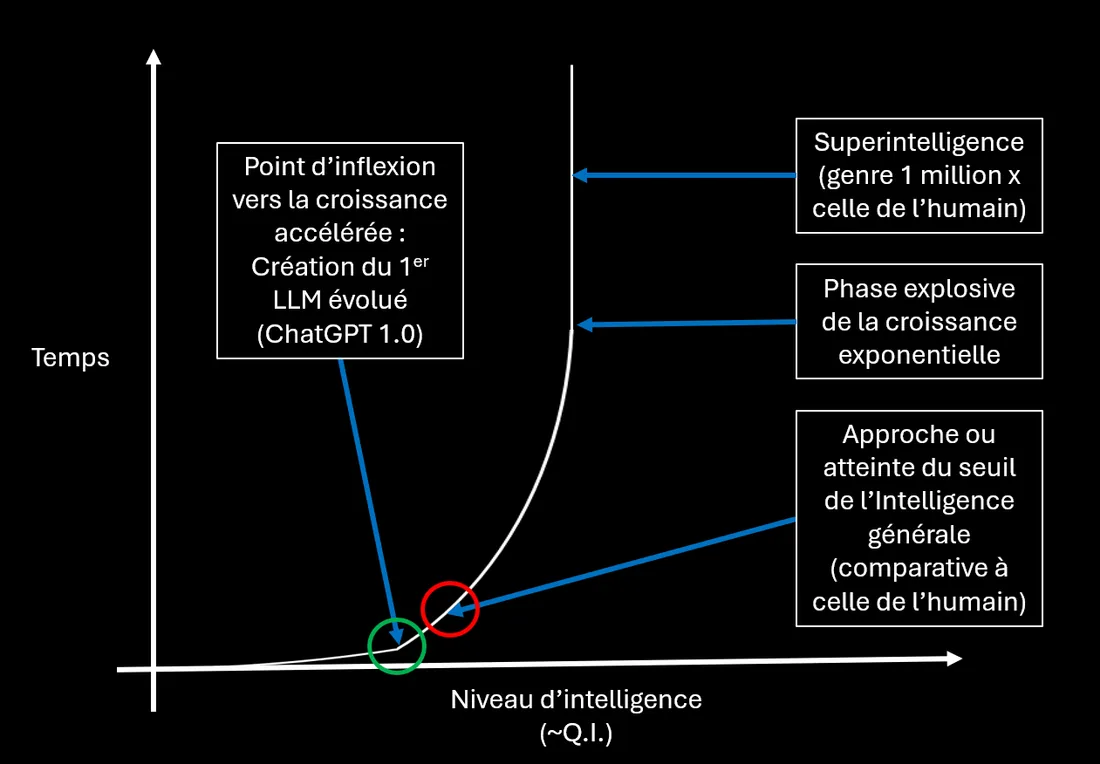
This is your wake-up call, and you cannot afford to hit snooze
I am going to be blunt: if you do not wake up NOW, you are going to get hit like a train — a hundred times worse than what happened to taxi companies when they tried to ignore Uber and Lyft instead of adapting. No, a thousand times worse. I do not think you grasp what is happening.
Sorry to be this direct, but if you have not yet realised what is going on, then you need the slap and the kick. Otherwise it is a meteorite that hits you, and your company gets a spot in the museum, next to the dinosaurs. Clear now?
A short history of AI
Artificial intelligence was first imagined by the public as intelligent robots. It is now clear that AI is mainly software, and is not confined to a local machine — it draws on pools of hardware that can be distributed anywhere. For a long time the intellectual capacity of that software lagged far behind humans, limited both by the data-processing power of the day and by the architectures and strategies of the models themselves.
- The dream phase. For decades, arguably centuries, humans have fantasised about artificial — that is, manufactured — intelligence.
- The long take-off, spanning nearly 70 years. Before OpenAI, major scientists laid the groundwork: Alan Turing (algorithms and computation), Warren McCulloch and Walter Pitts (the first artificial neuron model based on logical calculus), Frank Rosenblatt (the Perceptron, a neural network model that learns from data), John Hopfield (recurrent neural networks), David Rumelhart, Geoffrey Hinton and Ronald J. Williams (backpropagation, crucial to learning efficiently from complex data), Yann LeCun (convolutional networks, essential to image processing and deep learning), Yoshua Bengio (recurrent networks and autoencoders) and Jürgen Schmidhuber (Long Short-Term Memory networks). Together they paved the way for modern large language models.
- The inflection point. OpenAI's original breakthroughs came from a combination of factors: adopting and improving the Transformer architecture, using vast high-quality datasets, advanced training and optimisation techniques such as transfer learning and fine-tuning, substantial investment in compute, continuous frontier research, and the integration of community feedback to improve the models.
Market predictions
In 2025 the AI industry is estimated in the hundreds of billions of dollars, with forecasts of explosive growth potentially reaching trillions by 2030. There are more than 10,000 key players in the field, adoption by businesses is rapid, and over 70% of large companies have begun integrating AI into their operations to improve efficiency and decision-making. Technological advances are already delivering productivity gains in the order of 40%, significantly improving what these companies can offer while lowering their costs and raising their profits.
So what do you do now?
- Does your company already have a business strategist? If not, you need one — fast.
- Does your company already have an AI adviser? If not, you need one of those too.
Yes, I hear you: "I don't even have the budget to hire one person, and you want me to hire two?" Relax. You will not have to hire either of them full time. But you do need someone. In fact you need a coach and a doer — because you likely have neither the basic knowledge nor the time to get up to speed quickly enough.
In 1995 I already understood where computing was heading in business, which is why I studied networking and was already working in telecommunications. In 1999 I was among the first Canadians to study IP telephony, in California. By 2000 I was working on the web and predicting the evolution of the iPaq into a smartphone with internet access and applications — before the iPhone existed. In 2002 I was building my first websites, doing search engine optimisation and managing online advertising, which today we call internet marketing. My circle of friends included the owner of what was then the busiest French-language digital marketing site on the planet. Fast forward to 2015, and I was deploying complete marketing strategies covering distribution and every sphere of digital marketing, from affiliate to social media.
As for artificial intelligence, I have been educating myself on it for a long time through books and online publications. For more than fifteen years I have been telling people around me that the singularity was coming — I then placed it between 2025 and 2035. (The singularity is the hypothetical point at which technological development, artificial intelligence in particular, accelerates exponentially, surpassing human comprehension and radically transforming society.) When I raised AI and the singularity ten years ago, my professional circle had no idea what I was talking about and seemed uninterested. I am no Ray Kurzweil, but I have generally predicted which major technologies would emerge and roughly when — simply by logic, weighing their possible impact against the rate of scientific and technical progress.
I originally planned to move into this field gradually. Since last year I have realised the technology is advancing far faster than anyone imagined, myself included. We are right now at the heart of the inflection point of the growth curve. Which means growth will keep getting more accelerated from here. Not merely faster — more accelerated. In other words, faster squared.
Whoever you are, you have no choice but to dive in
- You own a large company? Your feet are probably already wet, but you need to dive head first, quickly — otherwise your company will not stay standing in front of the wave that is coming.
- You own an SME and you have perhaps exchanged a few chats with ChatGPT, Gemini, Grok or Claude? You are not really in AI yet, and it is time to wake up — as in now.
- You are an employee? You want to progress, or even just keep your job? Learn the tools, and hurry.
Don't panic
Even if you know nothing and are only waking up now, as long as you are committed to going at it, do not stress. You have two options.
- Option 1 — go it alone. Buy books on AI, subscribe to YouTube channels, research online (on ChatGPT, Gemini or Grok, not just Google), subscribe to software services, wade through it in the evenings, and dedicate 20–30% of your working day to catching the curve. Then, if you stay committed and coach your employees to keep pace, you will get there.
- Option 2 — bring in an adviser and doer. Meet a good business adviser with AI knowledge to educate you, help you think, draw up an action plan and implement it. Just start with one meeting. The rest follows on its own.
Author
Senior Business Adviser at MAVECO Canada, Pierre Vinet is an early adopter of emerging technologies and can support you through every stage of your digital and AI immersion. Contact him now.