Picture a maintenance company serving commercial buildings, with 46 contracts. Over time it adds four things to every one of them, all free: upkeep of the building record, a one-page monthly report, a capital planning note and a second note mid-contract. The price rises from $691 to $712 a month, yet the margin on a building in its territory falls from 59.08% to 52.08%. Nobody decided that. It is what happens when a value-added offer is never designed: it grows by itself, and you find out in the margin.
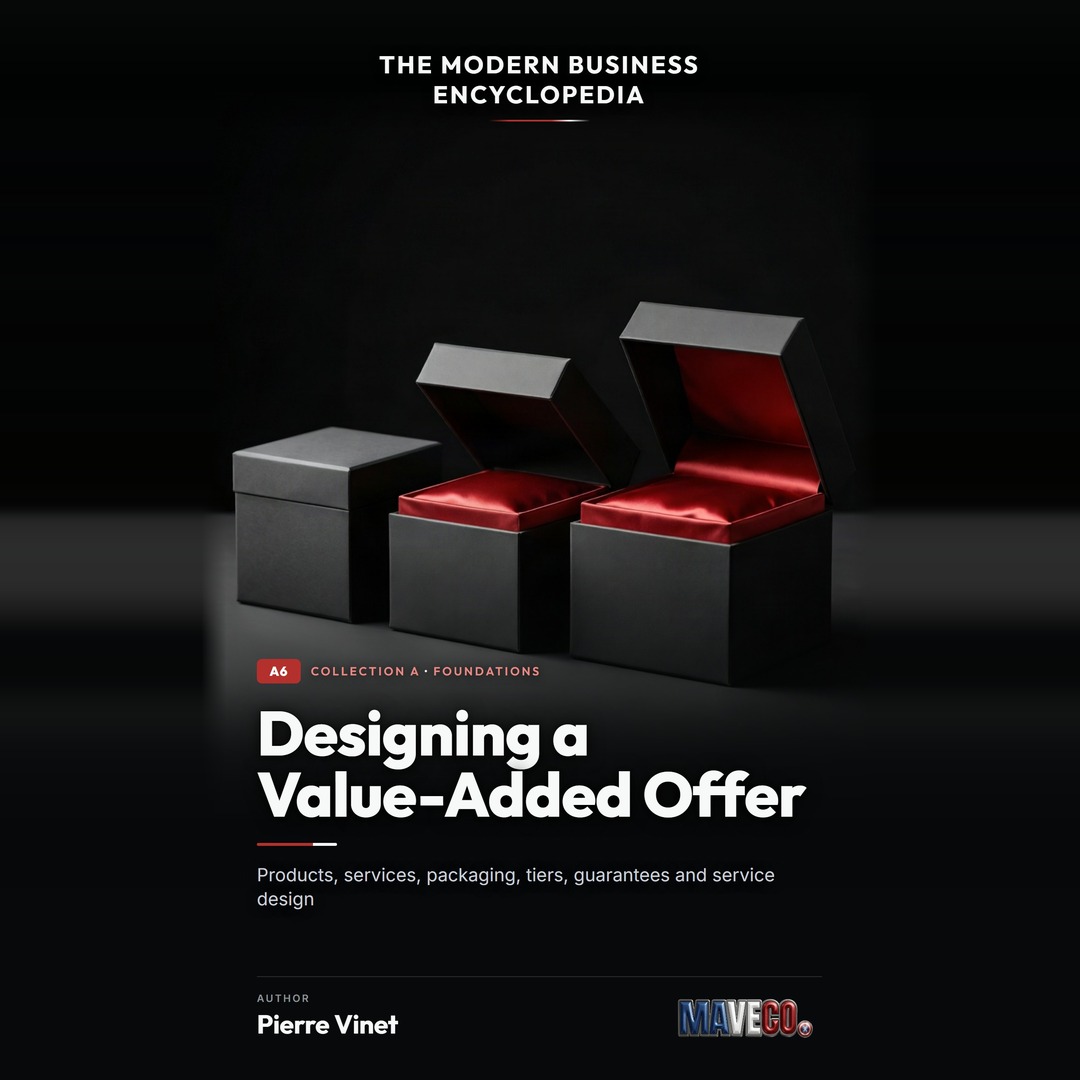
That company, Nordec Entretien inc., is fictional and its figures are illustrative. It is the running case of Designing a Value-Added Offer, the sixth book of The Modern Business Encyclopedia, the La Machine business library by Pierre Vinet. You can read the book free on maveco.ca. Here is what to take from it.
What is an offer, and how is it different from your value proposition?
A sentence such as "we do commercial maintenance" describes a capability, not an offer. In the book, an offer is the specific combination a customer can accept: what will be done, what they receive and do not receive, what the business commits to, and the terms of sale. When one of those four is missing, the customer's expectation fills the gap, and it is always more generous than the contract.
What are the five layers of an offer?
The book gives a simple frame for taking inventory of what you sell, from the centre outward:
- the core: the work itself, such as the monthly preventive visit;
- the promise: what you commit to, such as being on site within 90 minutes;
- the supplements: the services around the core, such as a report or a building record;
- the evidence: what the customer sees and keeps, such as the visit sheet or the report;
- the terms: price, duration, exclusions, renewal and the way out.
The three outer layers are the ones that drift without anyone deciding. To see it, the book proposes a five-step inventory: list every element the customer receives, date it, cost it per customer per month, mark what is billed and what is given, then write the three signals of an undesigned offer. Those signals are who says no and why, what customers ask for that nothing in the offer contains, and what you deliver without pricing it. At Nordec, the last one amounts to $20,700 a year of cost that no line covers.
How do you package an offer in three tiers without losing customers?
After twenty interviews, Nordec saw that one offer served two opposite groups badly. It gave too much to the owner of a small building, who found the contract bigger than the building needed, and too little to the property manager, who wanted one report across all of their buildings. The book's answer is tiers, each complete for a specific segment:
- an entry tier, fenced by size to buildings under 3,500 square metres;
- a middle tier, the full preventive program, which is the current contract cleaned up;
- an upper tier for the manager of several buildings, adding four things the managers themselves named.
The contents come from the interviews. Urgent response within 90 minutes was in the top three for 18 of the 20 people interviewed, and the capital planning note for 12. A fourth tier, planned for non-urgent night service, was dropped: no segment asked for it.
The book also adds single options, such as the capital planning note at $420 a year for the entry tier, which costs $162 to produce. It keeps three tiers and two options, drawing on a study in which people bought more jam and chocolate, and were more satisfied, when offered 6 choices instead of 24 or 30 (Iyengar & Lepper, 2000).
How do you design a guarantee you can afford?
A service cannot be inspected before it is bought, so the buyer carries a risk the business controls. The book draws on Hart (1988): the strongest guarantees are unconditional, meaningful to the customer, easy to understand and invoke, and easy to collect. The method takes five steps:
- name the promise customers value most, in their words;
- measure how often you miss it today;
- choose a remedy that is felt and automatic;
- price the failures at the current rate and at a bad year's rate;
- write the promise in plain words, exclusions included, and have a lawyer read it.
Nordec automatically pays a $150 credit when a technician is not on site within 90 minutes. At 96% of 253 calls, about ten misses a year, the guarantee costs $1,500, or 0.38% of contract revenue. At 88%, it would be about thirty misses and $4,500.
Should you give added services away?
Rarely. A free service is a pricing decision made by default. Drawing on Anderson and Narus (1995), the book asks you to design the services around the core as deliberately as the core itself. Every idea passes three tests, in this order:
- value to the target segment, measured by a count rather than an opinion;
- cost per customer per year, hours included;
- fit with the strategy, meaning what it strengthens and what it refuses.
The decision is then to include it in a tier, sell it separately or decline it, in writing and with the reason. Of eight candidate services, Nordec declined three, including an energy-efficiency check that reopened a path its strategy had closed.
How do you test the offer before rolling it out everywhere?
With a pilot whose rules are written before the first proposal. Nordec's had five: a close rate of at least 50% on at least ten proposals, at most one renewal in four moving down a tier, the entry tier at no more than 40% of new signings, a building assessment converting at least one buyer in four within 60 days, and no more than two guarantee credits a month. All five were met.
The honest reading stays cautious: six of ten proposals closed is 60%, but ten proposals carry a margin of error of about thirty points. So the pilot does not prove the tiers raised that rate. Six months later, in the fictional case, the company held 52 buildings and $447,012 a year in contract revenue, up 13.7% (illustrative figures).
The book's full plan fits in sixty days:
- days 1 to 15: inventory the offer and book twenty interviews;
- days 16 to 30: hold and count the interviews, draw the blueprint of the decisive moment;
- days 31 to 45: build tiers, options, a costed guarantee and the pilot's rules;
- days 46 to 60: start the pilot in a limited area and keep a weekly log.
How MAVECO can help
Reworking an offer takes numbers, method and an outside view. MAVECO supports small and mid-sized businesses in Québec in areas such as:
- offer management;
- profitability analysis of products and services, and pricing optimization;
- target customer identification;
- customer experience.
📘 Read the book free: Designing a Value-Added Offer.
📅 Let's talk about your offer: book a meeting with a MAVECO representative. In 30 minutes, we will tell you frankly where to start.
Frequently asked questions
What is the difference between an offer and a value proposition? The value proposition explains why a customer should care about your business. The offer is what the customer is handed when they decide to act: the contents, the exclusions, the commitments and the terms of sale.
How many tiers should you offer? The book sets no magic number. Three tiers are the smallest number that lets a buyer see a choice, and each must be complete for a segment that asks for it. Nordec keeps three, with two options.
Is the book free? Yes. Designing a Value-Added Offer is free to read on maveco.ca.
General information for educational purposes only. This article is not legal, tax, accounting or financial advice. Consult a qualified professional before acting.