In the spring of 2026, Camille Riopel, who sells hot sauces in Saint-Hyacinthe, receives a supplier agreement from a grocery chain in Ontario. The first page asks for the supplier's legal name, its registration number, its jurisdiction of incorporation and proof that the person signing can bind it. Camille has a well-known trade name, a partner, a lease, three employees and a bank loan under negotiation, but no single answer: the legal structure of the business was never chosen, and it changed twice without anyone writing down what each change had done. (Camille is a fictional character.)
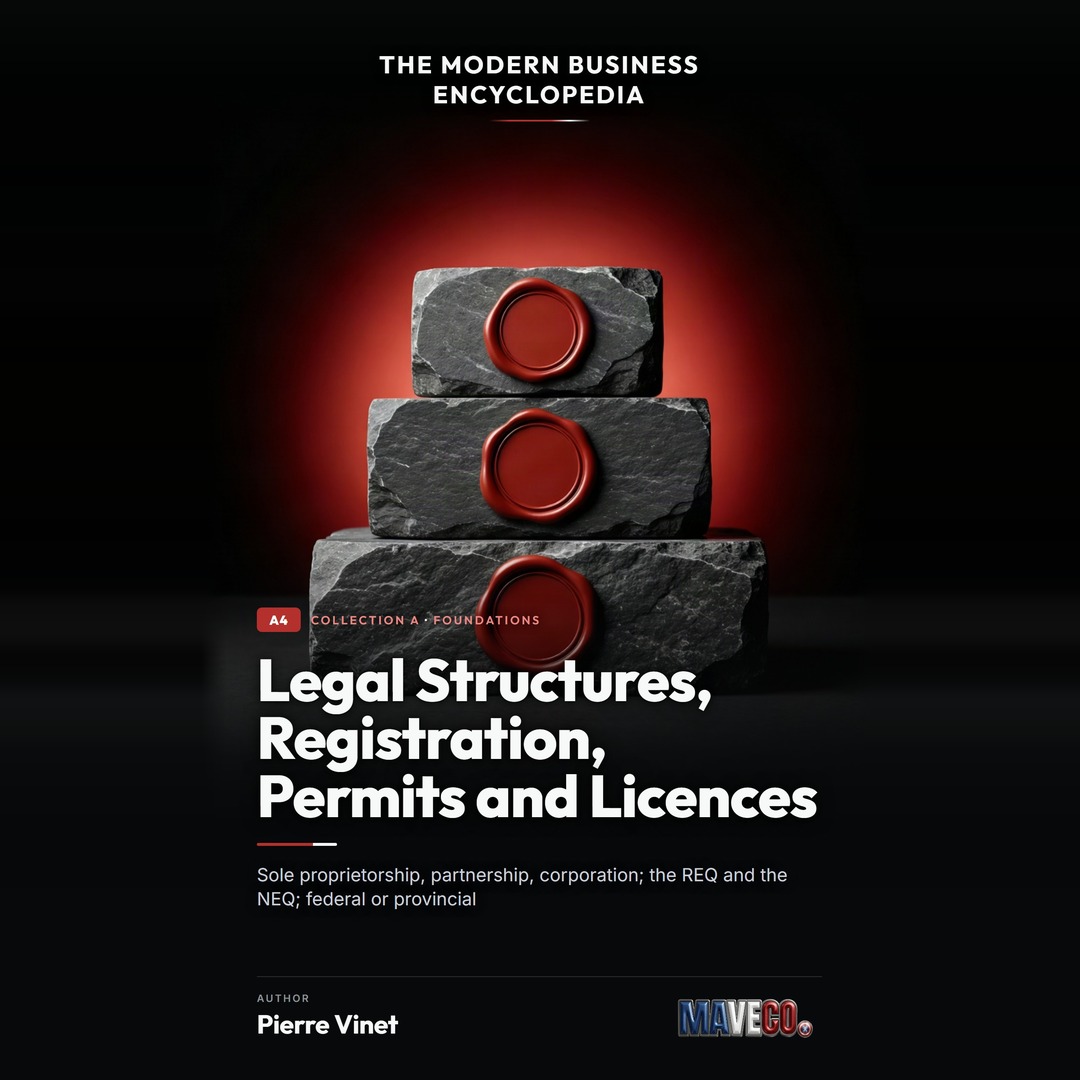
That situation opens Legal Structures, Registration, Permits and Licences, a book in The Modern Business Encyclopedia, the La Machine business library by Pierre Vinet. You can read it free on maveco.ca. Here is what to take from it.
What is a legal structure, and what does it decide for you?
Every business has one, even when the owner never chose anything. The book boils it down to one question: whose patrimony answers for the business's debts? Depending on the answer, the structure decides four things:
- Liability: who pays if the business cannot.
- Tax: who is taxed on the profit, at what rate and when.
- Credibility: what a bank, a landlord or a large customer needs to see before signing.
- Continuity: what survives when the owners change.
Canadian self-employed people organize themselves very differently depending on their situation. In 2025, according to Statistics Canada, 82.8% of those who employ others work through a corporation, while 63.5% of those who work alone are unincorporated.
What is the difference between a sole proprietorship, a partnership and a corporation?
- The sole proprietorship: one person, one patrimony. The business's debts are the owner's debts, house and savings included.
- The general partnership: two or more people. Once the partnership's property is exhausted, a creditor can claim the whole of an operating debt from any one partner. The 60/40 split of profits binds the partners among themselves, not the creditor.
- The corporation: a separate person with its own patrimony. Shareholders are not liable, as shareholders, for its acts.
Two people who work together and share profits already have a partnership, even without a signed contract: an undeclared partnership, with its own liability rules. The book recommends choosing deliberately: a registered general partnership with a written agreement, a corporation, or a contract between two separate businesses.
What does a corporation really protect?
A lot, but never everything. The book measures it on its fictional case, Sauces Riopel. On September 30, 2026, in a scenario where the business stopped paying, the partners could owe $649,050 out of their own pockets: the lease, a $180,000 equipment loan, supplier credit, a $250,000 claim beyond insurance and six months of wages. After incorporation, $249,000 remains: the personally guaranteed loan and, for the directors, six months of unpaid wages. The corporation removes 61.6% of the exposure, not 100%. (Illustrative figures.)
On tax, a corporation defers more than it saves. On $176,000 of profit, the case's corporation keeps $61,000 taxed at 11.2% rather than 36.1%: $14,519.84 less tax in the first year. Once that profit is paid out as dividends, the total exceeds the partners' by $926.39. (Illustrative figures, 2026 parameters.) Deferral is useful if the business keeps its money to invest; it is worth almost nothing if everything is withdrawn every year.
Another trap: a federal incorporation does not exempt you from registering in Québec, and it does not protect a name against a competitor's trademark. A registered trademark does, across Canada.
When must you register, and what are the REQ and the NEQ?
Incorporating creates a legal person; registering enters the business in the Québec enterprise register (REQ), which is public and free to search and which issues the Québec enterprise number (NEQ). You must register, within 60 days, if you operate under a name other than your own full name, if you form a partnership in Québec, or if your corporation, federal ones included, carries on an activity in Québec. A consultant who invoices under their full name has no obligation.
The 2026 public fees are $41 for an individual, $63 for a partnership and $397 for incorporating a corporation, registration included. Failing to register is an offence with a fine of $2,000 to $20,000. Two years without an annual update can lead to cancellation of the registration and, for a Québec corporation, to its dissolution.
The register also shows who controls the business: the ultimate beneficiaries, who hold at least 25% of the voting rights or of the value of the shares, appear on it. And a corporation constituted in Québec must ask the Canada Revenue Agency for its business number itself.
When must you register for sales taxes and as an employer?
The threshold to watch is $30,000 of taxable sales over four consecutive calendar quarters. Above it, small supplier status ends at the end of the following month. In Québec, the QST application must be filed before the first taxable sale that follows; the 29-day delay applies to the GST only. A missed registration is expensive, because the tax becomes collectible even if it is not on the invoice: for the case, $9,913.45, or 40.1% of the year's profit. (Illustrative figures.)
A first employee requires three registrations: the payroll account with the Canada Revenue Agency, before the first remittance; the source deductions file with Revenu Québec; and the CNESST employer file, within 60 days of the first day of work.
What happens when you change structure?
Every number, account and permit belongs to a person, and often to a place. When the sole proprietorship becomes a partnership and then a corporation, the numbers do not follow: the new person gets its own. The book offers a 21-step plan over 30 days, with three checkpoints. For the fictional case, the setup takes 45.5 hours of the owners' work, then 31.5 hours a year to keep up.
How MAVECO can help
Choosing a legal form is done with a notary or a lawyer and an accountant; MAVECO does not give legal or tax advice. Here is what we do around that choice:
- business planning, to measure profit, risks and financing needs before choosing a form;
- operational process optimization, so that every deadline (updates, returns, renewals) has an owner;
- accounting and contract review, through partners.
📘 Read the book free: Legal Structures, Registration, Permits and Licences.
📅 Let's talk about your project: book a meeting with a MAVECO representative. In 30 minutes, we will tell you frankly where to start.
Frequently asked questions
Do I have to register a sole proprietorship in Québec? Only if you operate under a name other than your own full name. In that case, the declaration is due within 60 days. Voluntary registration is also possible.
Does a corporation protect all my personal assets? No. The personal guarantees you sign, the directors' liability for unpaid wages and remittances, and a court's power to set the corporation aside in cases of fraud all remain.
Does a corporation pay less tax? It defers tax on the profit it keeps. When that profit is paid out as dividends, the total comes close to what the owners would have paid directly.
Is the book free? Yes. Legal Structures, Registration, Permits and Licences is free to read on maveco.ca.
General information for educational purposes only. This article is not legal, tax, accounting or financial advice. Consult a qualified professional before acting. The rules and amounts cited are those of the book, as of September 10, 2026: check them with the official source.