Picture a company in Sherbrooke that designs connected water-leak detectors. It assembles its kits in its own workshop, and its staff installer also does the installations at customers' buildings. One year the bench runs short of hours and installations fall behind. Should the company buy the assembly elsewhere? Keep it? Do some of each? That is the question of vertical integration: which stages of your chain do you own, and why?
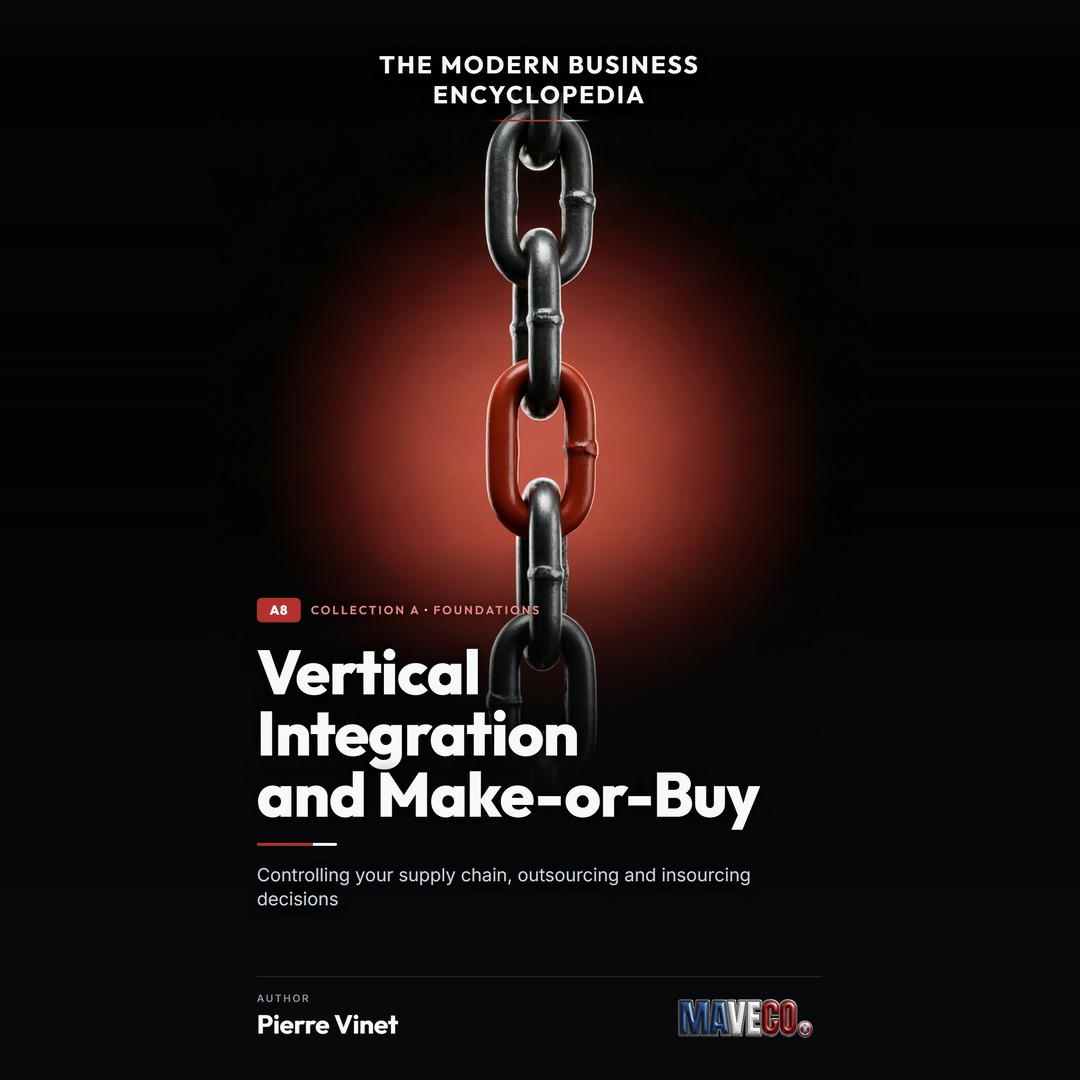
It is the subject of Vertical Integration and Make-or-Buy, a book in The Modern Business Encyclopedia, the La Machine business library by Pierre Vinet. You can read it free on maveco.ca. The company in the example, Hydrosentinelle inc., is fictional, and every figure about it is illustrative.
What is vertical integration, and what is it not?
The book defines it as a matter of degree: a business is more or less integrated depending on how many stages of the chain, from inputs to customer, it owns itself. Owning a stage upstream (components, tooling) is backward integration. Owning a stage between you and the customer (installation, service) is forward integration.
Buying from a supplier is not integration. Neither is a long-term agreement that leaves ownership where it was. Ownership brings fixed cost, management and risk, while an agreement brings a promise and a price.
The book's starting point is simple: every business has a boundary, whether or not anyone drew it. A business that cannot say which stages it owns cannot say what it depends on.
How do you decide, one activity at a time: make, buy or partner?
The book insists on the unit of decision: one whole activity at a time, never the business as a whole. The firmware may deserve to stay in-house, the circuit boards to be bought, the installation to be shared with partners. A single verdict for the whole chain would be an average, and an average is not a decision.
For each activity, the book's method has five steps:
- List the whole activities of the chain, one by one.
- Weigh six criteria so the weights add up to 100, and write down why.
- Score each activity from 1 to 5 on each criterion, where 5 favours making.
- Turn the scores into points and read the total: make at 75 or more, a hybrid form from 55 to 75, buy below 55.
- Write the verdict, the reason, the person who disagrees and the date of the next review.
The six criteria in the example, with their weights: how central the activity is (25), the company's capability against its suppliers' (20), how specific the assets and knowledge are (20), the cost of making against buying (15), the risk of relying on the market (10) and the control the business needs (10). The book is clear that this grid is its own, that no source tests it, and that each business writes its own weights.
At Hydrosentinelle, the firmware and alert logic score 92, so they stay in-house. The electronic boards and the hosting score 35, so they are bought. Final assembly, the enclosure tooling and installation land in a hybrid form, at 57, 68 and 71.
Which costs should you compare to know whether to make or buy?
A supplier's price is only one line of the cost. The book asks you to compare made and bought on the same basis: same unit, same period, same volume, hours valued at the same rates. On the making side, count materials, hours, scrap and rework. On the buying side, count the price, freight, oversight and receiving.
In the illustrative example, a kit assembled in the workshop costs $175.50 and the same kit bought, with freight and oversight, costs $202. Buying costs $26.50 more per kit.
Why buy something that costs more to buy than to make?
Because a price comparison is only half a comparison. A made cost assumes the hours exist. In the case, the bench needs 713 hours of the staff installer in the year, and only 600 are free. That leaves a gap of 113 hours, which would hold back 37 kits by about three months each, delaying $14,319 of monthly fees (illustrative figures).
So the company buys 207 of its 230 forecast kits and keeps 23 in the workshop for repairs, pilot builds and urgent orders. The book calls this making and buying the same thing at once: it keeps the know-how alive, but it costs some of the volume on each side.
The molds go the other way. Owning the second-generation enclosure molds costs $72,000 and brings the enclosure set down to $64 a kit, against $134 if the molder keeps the molds. The $70 difference pays back the molds after 1,028.6 kits, in year 4 of a five-year life of 1,400 kits. At an assumed rate of 9 percent the net present value is $3,068, but minus $8,304 if volume falls 15 percent. The numbers are thin, and control of an asset that is specific to this product is what decides.
How do you hand off an activity without losing control?
The book treats moving an activity as a project, not a price. What leaves is not only the work. The know-how, the records, the risk and the oversight you now owe all go with it. What never leaves is your duty to your own customers.
The steps it proposes:
- Write a specification and an acceptance test before asking for quotes, so two offers answer the same question.
- Compare providers on five criteria: capability, capacity, quality, total cost and continuity.
- Run pilot builds, inspecting every unit, while the old method is still running.
- Sign the agreement after the pilots are accepted: price, quality, capacity, confidentiality and exit.
- Keep the means to go back: the test protocol, a duplicate test bench, the records and a small in-house cell.
In the case, the company keeps control of what matters: it supplies the firmware image and runs its own end-of-line test on its own bench. The book also reminds readers that a lawyer should read any contract, and that it tells no one whether a given agreement is lawful.
When should you bring an activity back in-house?
The book recommends writing the thresholds in advance, because a threshold written before the event is a decision, while a threshold discovered during the event is a quarrel. The example's thresholds are illustrative: assembly comes back in-house if the defect rate exceeds 2 percent for two months running, if the price passes $215 a kit, or if three releases in a year arrive late.
Each decision goes into a register with its reason, its owner, its triggers and its review date. The book lays it all out as a 90-day plan in three slices, with a gate on days 30, 60 and 90.
It promises no saving. It cites a study that found no significant direct effect of outsourcing peripheral and near-core tasks on firm performance (Gilley & Rasheed, 2000), and another reporting that neither outsourcing nor internalization by itself gives superior performance (Leiblein et al., 2002). Each business therefore decides with its own grid and its own numbers.
How MAVECO can help
Drawing the boundary of your business takes reliable numbers and an outside view. MAVECO works with Québec small businesses on neighbouring topics:
- supply agreements;
- operational process optimization;
- profitability analysis of products and services, and pricing optimization;
- strategic partnerships;
- through partners: contract review and cost audits.
📘 Read the book for free: Vertical Integration and Make-or-Buy.
📅 Let's talk about your project: book a meeting with a MAVECO representative. In 30 minutes, we will tell you plainly where to start.
Frequently asked questions
What is the difference between vertical integration and outsourcing? Vertical integration means owning several stages of the chain. Buying an activity from a supplier is not integration: you pay a price and ownership stays where it was.
Should you always make what costs less to make? No. The book shows that a kit can cost less to assemble yourself and still be reasonable to buy, when the hours needed do not exist.
How many activities should you decide at once? One. The book decides each whole activity separately, with a grid, a written reason and review triggers.
Is the book free? Yes. Vertical Integration and Make-or-Buy is free to read on maveco.ca.
General information for educational purposes only. This text is not legal, tax, accounting or financial advice. Consult a qualified professional before acting.