Two cofounders print their second-year results and lay them beside the sheet they filled in before their first customer. Two lines are identical: the price of an installed kit, $4,800, and the price of the monthly monitoring subscription, $79. Nobody decided to keep them, and nobody can justify them in a sentence a customer would accept. If that sounds like your company, your pricing strategy may be overdue.
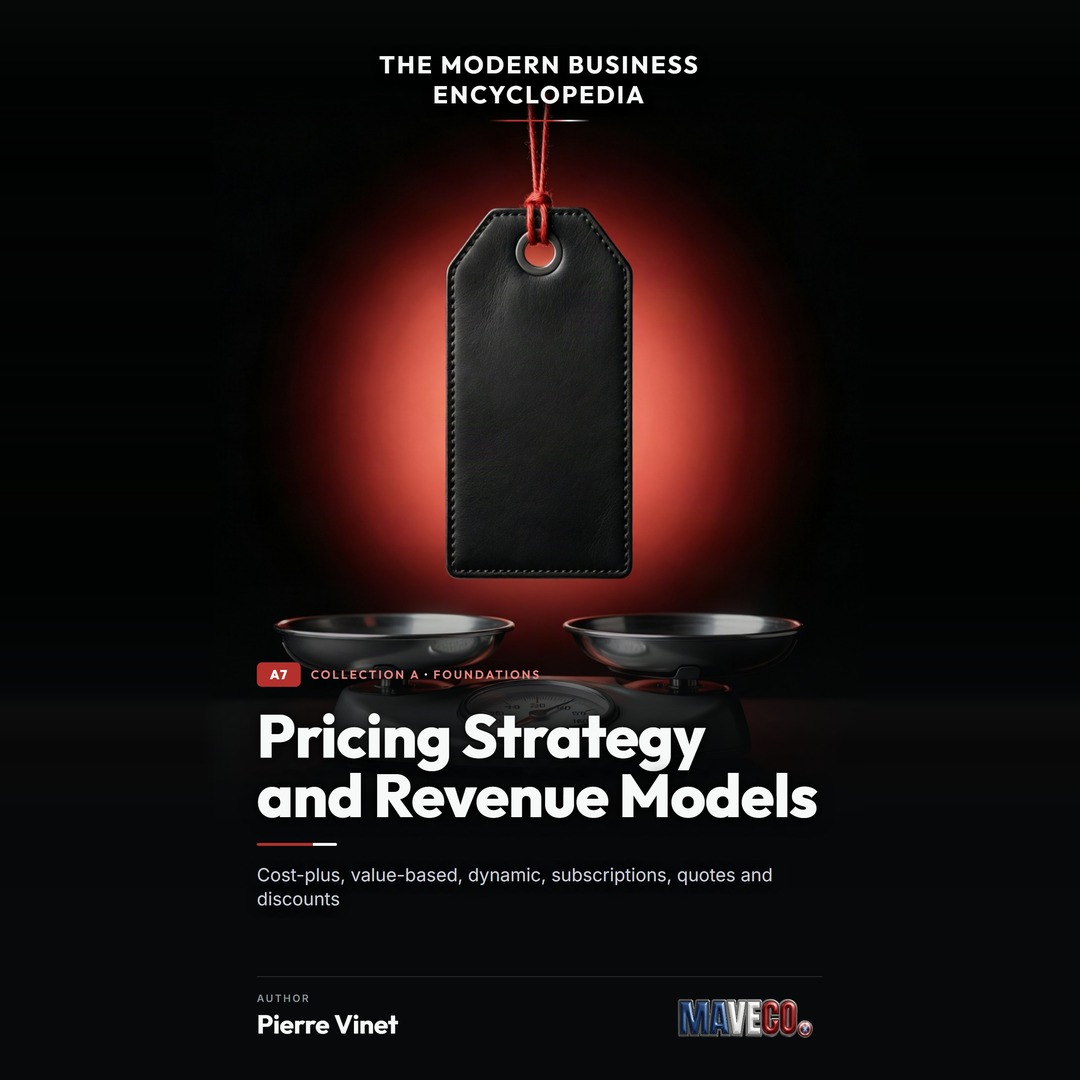
That scene opens Pricing Strategy and Revenue Models, a book in The Modern Business Encyclopedia, the La Machine business library by Pierre Vinet. You can read it free on maveco.ca. The company in the book, Hydrosentinelle inc., is fictional, and its names and figures are illustrative. Here is what to take from it for your business.
Why is price the strongest profit lever?
A business has four levers on its operating profit: price, volume, variable cost and fixed costs. The book compares them on one year of the illustrative case, with revenue of $1,130,388 and operating profit of $181,808. One percentage point on each is worth:
- Price: $11,303.88, with volume unchanged;
- Volume: $7,018.08;
- Fixed costs: $5,200.00;
- Variable cost: $4,285.80.
The reason is arithmetic. A price increase that customers accept requires no extra activity: same units, same suppliers, more money. The book is careful to say that the calculation holds volume constant. It measures what is at stake, and it does not predict the outcome.
How do you set a price: cost, competition or value?
The book's answer is that each method measures a different limit. Cost sets the floor: below it, every sale makes the business poorer. Competition sets the reference: the buyer will compare, whether or not you take part. Value sets the ceiling: nobody pays more than the offer is worth against their best alternative.
Two traps come up often. The first is confusing markup with margin. In the case, a kit that costs $2,100 and sells for $4,800 carries a 128.57% markup and a 56.25% margin. Someone who wants a 40% margin and multiplies cost by 1.40 actually gets 28.57%. The second trap is letting suppliers set your price: cost-plus pricing imports your suppliers' decisions into the price your customers pay.
The book proposes estimating value to the customer instead. For a 48-unit rental building, the case estimate comes to $5,668 a year against an annualized price of $1,908. The company captures 33.66% of the value it creates, and the customer keeps the rest, which is the customer's reason to switch.
How much does a discount really cost?
A 10% discount on a $4,800 kit is $480. That is not 10% of something you have plenty of: it is 17.78% of your $2,700 margin. To earn the same total margin, you would need to sell 21.62% more units.
The book then shows that the visible discount is not the real one. On one negotiated order in the illustrative case, the invoice shows a 6% discount. Yet 17.21% of the list price vanished before the company kept anything, and 30.59% of the margin with it. Three concessions never touched the invoice, for $312.28 in all:
- payment terms of 60 days instead of 30;
- a pack of spare parts given free, counted at cost;
- unbilled installation hours.
Nobody decided to grant them. Each was a small favour from a different person. The book calls the result the "pocket price."
What should you ask for in exchange for a discount?
The book's rule fits in one sentence: never give a discount, trade it. It rests on three tools written in advance:
- A floor expressed as a margin, not as a maximum discount. In the case, a 40% minimum margin on a $2,100 cost gives a $3,500 floor, measured on the pocket price.
- A ladder of authority: 6% for the sales representative, 12% for the head of sales, the floor for the president, and nothing below it without a written exception.
- A list of counterparts: larger volume, a multi-year term with indexation, payment in advance or a deposit, a reference you may publish, a reduced scope, a faster decision.
The book adds two cautions. Permission to publish a reference is signed at the same time as the discount, not later. And the discount for annual prepayment should be computed: in the case, a 10% discount works out to an implicit rate of about 22% a year, which is expensive financing, even if better retention may justify the trade.
How do you raise prices without losing customers?
A price that is never touched is falling, because everything around it rises. In the case, the 206 existing subscribers pay $79 a month while new customers pay $89 for the same service.
Before writing the letter, the book asks the right question: how many customers could you lose and still be no worse off? The answer is a division. A $10 step, divided by the contribution after the increase ($74), gives 13.51%, or 28 of 206 subscriptions. The model assumes a loss of 6. The case gives 60 days of notice, then 6 months of grandfathering, then one single step. The illustrative result: $9,696 in the year of the increase (6 months at the new price) and $19,392 in a full year.
The book adds a nuance: if your customers switch easily, raise prices for new customers first, watch your win rate for two quarters, and only then move the existing base.
Where do you start in 30 days?
The book offers a four-week plan of about 44 hours in all, or 11 hours a week:
- Week 1, find out what you really charge: read 12 months of your own pricing, build a margin model, draw the pocket price waterfall of your three largest orders.
- Week 2, level and shape: estimate value, choose the revenue model, build three tiers.
- Week 3, policy: floor, authority, a one-page policy, the decision on an increase.
- Week 4, publish and schedule: a price page or quote template, legal checks, a quotation log.
The order matters, the book insists, because the floor depends on the level, and the level on the value. It also gives a simple presentation rule: the first price the buyer sees is the price they pay, apart from taxes.
How MAVECO can help
Setting a floor, building a price ladder and structuring quotes take reliable figures and an outside view. MAVECO supports that work for small and mid-sized businesses in Québec:
- profitability analysis of products and services, and pricing optimization;
- quote generators;
- offer management;
- sales cycle.
📘 Read the book free: Pricing Strategy and Revenue Models.
📅 Let's talk about your prices: book a meeting with a MAVECO representative. In 30 minutes, we will tell you frankly where to start.
Frequently asked questions
What is the difference between markup and margin? Markup divides the amount added by the cost, margin divides it by the price. A 50% markup is a 33.33% margin. State your targets as a margin on price.
What is the pocket price? It is what the business actually keeps after every discount, payment term, free item, unbilled hour and rebate. It is often well below the invoice price.
Should you publish your prices? The book recommends it when the offer is standard, the cost to serve is stable and no negotiation is expected. A hidden price, it says, signals an expensive one the seller is embarrassed by.
Is the book free? Yes. Pricing Strategy and Revenue Models is free to read on maveco.ca.
General information for educational purposes only. This article is not legal, tax, accounting or financial advice. Consult a qualified professional before acting.